
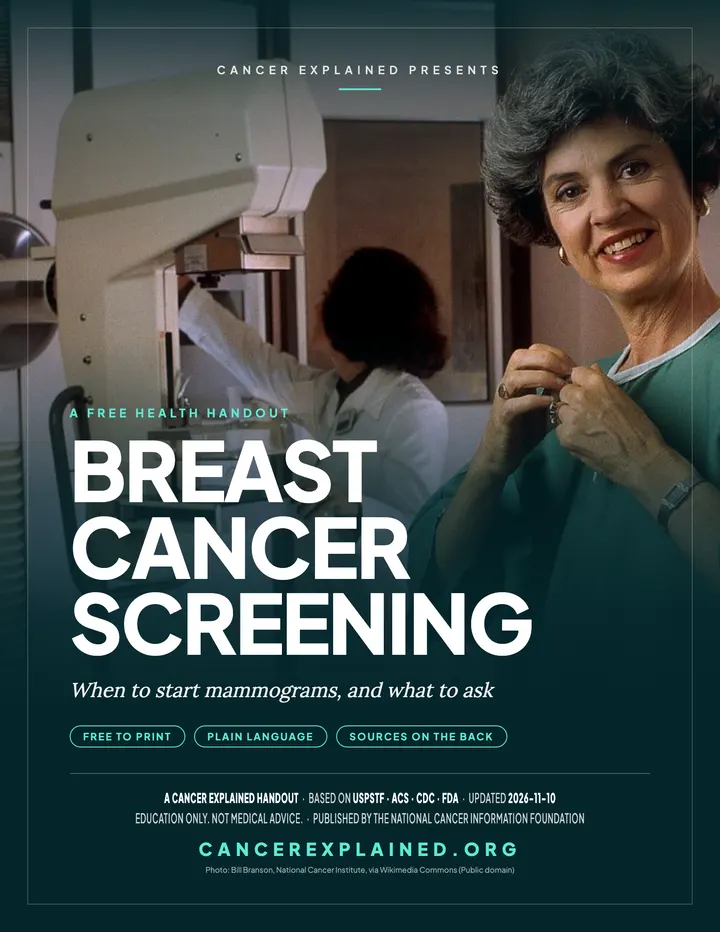
CancerExplained.org · Free health handout
Breast Cancer Screening
When to start mammograms, and what to ask
For women at average risk
- U.S. Preventive Services Task Force: a mammogram every 2 years from age 40 to 74.
- American Cancer Society: the choice to start yearly at 40 to 44, yearly from 45 to 54, then every 2 years or yearly from 55.
- The two guidelines differ a little. Ask your doctor which schedule fits you.
You may need a different plan if
- A parent, sister, brother, or child had breast or ovarian cancer.
- You carry a BRCA1 or BRCA2 gene change, or a close relative does.
- You had radiation to the chest when you were young.
- Tell your doctor. Screening may start earlier or include a breast MRI.
About the test
- A mammogram is a low-dose x-ray of each breast. The pressure lasts a few seconds.
- Being called back for more pictures is common, and most call-backs are not cancer.
- Your results letter will say whether your breasts are dense. Dense tissue can make cancer harder to see, so ask what it means for you.
Do not wait for a screening date if you notice
- A new lump in the breast or underarm.
- Skin that dimples, thickens, or turns red or flaky.
- A nipple that turns inward, or discharge other than breast milk.
- A change in the size or shape of a breast.
My screening
- Date of my last mammogram: ____________
- My next one is due: ____________
From 40, ask your doctor when to start mammograms and how often. Report any breast change at any age.
This handout is for education only and is not medical advice. Talk with a qualified healthcare professional about what is right for you.
Sources: USPSTF: Breast cancer screening · ACS: Breast cancer screening guideline · CDC: Symptoms of breast cancer · FDA: Mammography breast density reporting rule. Updated 2026-11-10.
Learn more in plain language: https://cancerexplained.org/essentials/breast-cancer/ — free to copy and share for non-commercial education.