
NewsMovies & TV
The 'Half-Million-Dollar Cancer Vaccine' Reel: What's Real About Personalized mRNA Vaccines
A viral Instagram Reel says a publicly funded personalized cancer vaccine is being patented and priced at half a million dollars. Here's what the science and the record actually show.
Original commentary from the Cancer Explained editorial team.


Please note: this page is educational only — it is not medical advice, and it does not speculate about anyone’s health beyond reliable public reporting. For questions about your own health, talk with your healthcare team.
“A technique built over decades on publicly funded research is now being patented and priced at half a million dollars.”
Nothing has loaded from Instagram. We do not connect you to Meta unless you ask, because that would let them set cookies through this page. Open it on Instagram instead.
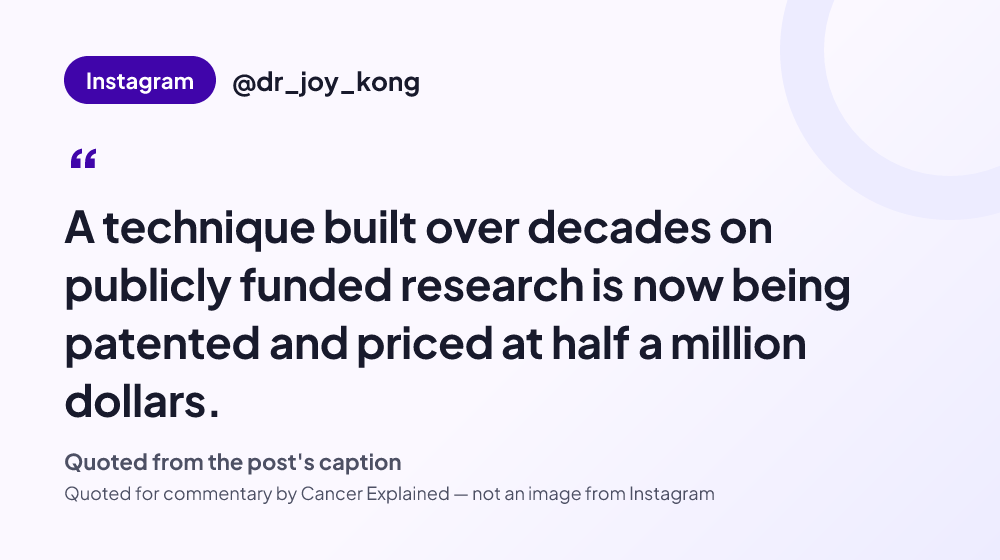
A viral Instagram Reel from Dr. Joy Kong reacts to a discussion between entrepreneur David Sacks on the "All-In Podcast" about a new cancer treatment. It's a vaccine built from a patient's tumor DNA, teaching the immune system to attack it. Kong calls the science "beautiful." But she argues that publicly funded research is now "patented and priced at half a million dollars." She warns that FDA approval of regenerative therapies could raise prices once insurance and big pharma get involved. She puts the jump at $5,000–$35,000 now to $100,000–$500,000.
What the science actually says
The technology is real. It's one of the most exciting cancer research developments in years. Personalized mRNA vaccines work by sequencing a tumor, to find mutations that make abnormal proteins called neoantigens. Algorithms predict which neoantigens will best train immune cells to recognize cancer. A vaccine can include sequences for dozens of neoantigens. Manufacturing usually takes one to two months after biopsy.
The product in question appears to be the melanoma vaccine from Moderna and Merck. It's developed as mRNA-4157 (V940), and now called intismeran autogene. It's given with the drug pembrolizumab (Keytruda), after high-risk melanoma surgery. Trial data (KEYNOTE-942) shows it meaningfully lowers the risk of recurrence or death, compared to pembrolizumab alone. Follow-up data from 2026 shows lasting reductions, years after treatment.
No mRNA cancer vaccine has full FDA approval yet. The field is investigational, with dozens of trials underway in melanoma, pancreatic, colorectal, and other cancers. The product got expedited review designation, meant to speed approval of promising therapies. But "expedited review" is not the same as "on the market." No federal source confirms a $500,000 price. Makers haven't published a price, because the treatment isn't approved or sold.
What this video gets right or wrong
Kong is right that neoantigen vaccines are real and promising. She's also right that decades of NIH- and university-funded research into tumor genomics, mRNA, and immunology later got licensed to private companies. Much of it was publicly funded. The tension between public discovery and private pricing is a real, widely discussed policy issue in cancer research.
The video's weak point is the specific dollar figure. A $500,000 price for this unapproved vaccine isn't supported by federal records. There's no approved product to price yet. Presenting a projected price as fact goes beyond what we actually know. The video also blends two topics: an investigational vaccine, and a prediction about future stem cell therapy pricing. Blending them makes an unapproved product sound closer to market, and more definitely priced, than it really is.
Signs and symptoms
Melanoma often first appears as a new or changing mole. Watch for: asymmetric shape, irregular borders, uneven color, size larger than a pencil eraser, or a change in size, shape, or color (the "ABCDE" pattern). A sore that won't heal, or a dark streak under a nail, can warn too. Most unusual moles aren't melanoma. But any new or changing skin lesion needs a clinician's look, since early detection helps a great deal.
What to do instead
Do you have melanoma or another cancer, and want to know about vaccine or immunotherapy trials? Start by talking to your oncology team. They can check eligibility through the NCI's trial search. Cost worries are worth raising with your care team and financial counselors too. Assistance programs, insurance appeals, and free trial enrollment can all change what you actually pay — often very different from the list price. To help prevent melanoma: limit UV exposure, use sunscreen, and get new or changing skin spots checked fast. It's highly treatable when caught early.
Supporting rigorous cancer research and patient education helps keep science and facts accessible. Nonprofits work to keep this info free for anyone making sense of a diagnosis or viral claim.
How this article was prepared
An AI-assisted editorial system helped prepare this page. No named medical reviewer has reviewed it unless one is listed.
Cancer Explained is published by the National Cancer Information Foundation. It is not medical advice and does not suggest a test or treatment.
See an error, old source, or unclear wording? Tell us.
Know someone who needs this?
Plenty of people are looking for something like this and do not know where to start. If this would help a friend or someone you love, send it on — we have written an opening line so you do not have to stare at an empty message. You can change every word of it.
Your message is written and sent in your own email or messaging app — we never see who you send it to, and nothing is added to any list.
Put the story in context
Prevention, possible warning signs, screening, and diagnosis
This story relates to melanoma. The information below is general: it does not reveal anything else about a public person’s health, and not every point applies to every cancer. Personal advice depends on age, symptoms, family history, exposures, and medical history.
Prevention and risk reduction
Not every cancer can be prevented. Avoiding tobacco, protecting skin from ultraviolet radiation, limiting alcohol, staying active, and receiving recommended HPV or hepatitis B vaccination can lower the risk of certain cancers. A risk factor is not a prediction or a cause in one individual.
Symptoms and possible early signs
Possible signs vary and are often caused by conditions other than cancer. Changes worth discussing include a new lump, unexplained bleeding or weight loss, a persistent cough, lasting bowel or bladder changes, a changing skin spot, or symptoms that persist or worsen. Some early cancers cause no symptoms.
Screening and early detection
Screening looks for certain cancers before symptoms begin. Recommended tests exist only for some cancers and depend on age and risk. Screening can have benefits and harms; it is not the same as evaluating a new symptom, and there is no single routine scan or blood test that reliably screens for every cancer.
How cancer is diagnosed
Diagnosis may involve a history and exam, imaging, laboratory tests, and often a biopsy. Pathology can identify the cancer type and may test biomarkers that guide treatment. Symptoms, screening results, tumor markers, or online stories alone cannot confirm cancer.
Learn about this story’s cancer topic
A public story may encourage questions, but it should not be used to estimate your risk or choose testing. Contact a healthcare professional about a persistent or concerning change. Seek urgent care for severe or rapidly worsening symptoms.