
NewsMovies & TV
No, Kiwis Won't Rebuild Your Skin (Or Prevent Cancer): The Truth About That Viral Vitamin C Study
A viral Instagram Reel claims eating two kiwis a day boosts skin density 48% and skin cell regeneration 30%. Here's what the actual vitamin C research says — and why 'more antioxidants' isn't a cancer-prevention shortcut.
Original commentary from the Cancer Explained editorial team.


Please note: this page is educational only — it is not medical advice, and it does not speculate about anyone’s health beyond reliable public reporting. For questions about your own health, talk with your healthcare team.
“Eating just 2 kiwis a day increased skin density by 48% and skin cell regeneration by 30% in 8 weeks.”
Nothing has loaded from Instagram. We do not connect you to Meta unless you ask, because that would let them set cookies through this page. Open it on Instagram instead.
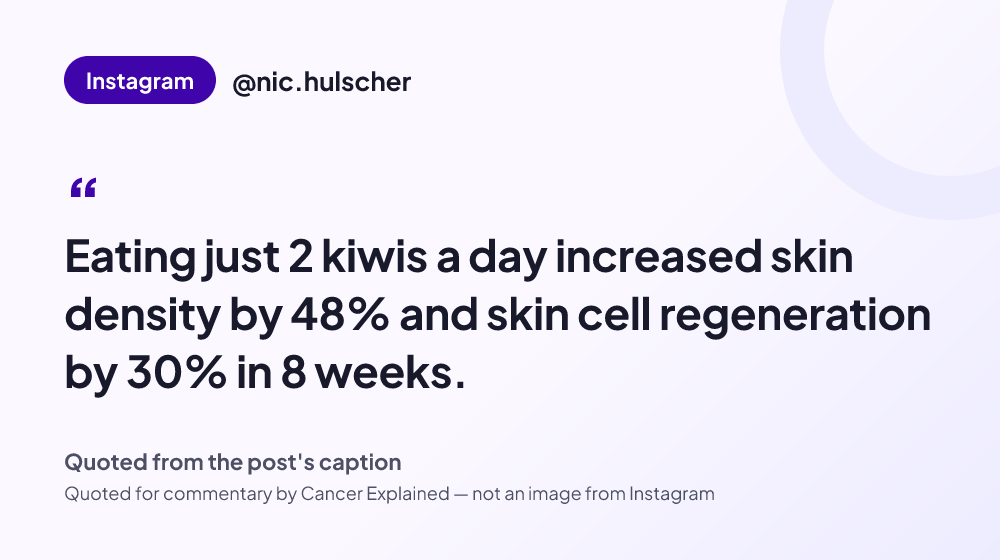
A viral Instagram Reel from the account nic.hulscher has racked up nearly 30,000 likes. Its headline makes a bold claim: "STUDY: EATING JUST 2 KIWIS A DAY INCREASED SKIN DENSITY BY 48% AND SKIN CELL REGENERATION BY 30% IN 8 WEEKS."
The caption adds that vitamin C levels "significantly increased in the blood, skin fluid, and epidermal tissue, improving skin structure from the inside out."
The video did not fully load during our review. So this article checks the caption text visible on the post — that's the claim being fact-checked here. This kind of post shows up constantly in wellness and "natural health" corners of social media. The pattern is familiar: cite a real-sounding statistic, suggest a food is a near-magical fix for skin (and health in general), and let the numbers do the convincing. This account, like others, often frames nutrition claims as alternatives to mainstream medical advice. That makes it worth asking what the actual science on vitamin C supports. It matters even more because vitamin C is also heavily marketed online as a cancer-fighting supplement.
What the science actually says
Vitamin C is a real, essential nutrient. It plays a proven role in skin health. The National Institutes of Health's Office of Dietary Supplements says vitamin C "is required for the biosynthesis of collagen." Collagen is a protein. It gives skin its strength and stretch. Vitamin C also plays "a vital role in wound healing." Small studies link vitamin C levels to skin quality. So a study on better skin density after more vitamin C is plausible. That's true whether the vitamin C comes from kiwifruit or another source. Kiwifruit is, in fact, a vitamin-C-rich fruit.
But no one can check the Reel's numbers — 48% and 30% — against the original study. The caption names no researchers. It names no journal. It doesn't say where the data appeared. A single, small trial funded by the kiwifruit industry is not the same as broad, independent proof. That kind of trial can't support big claims like "improving skin structure from the inside out."
These posts suggest something bigger, too: that more vitamin C also lowers cancer risk in a real way. Here the evidence is much weaker than the skin claim suggests. The National Cancer Institute (NCI) says plainly that "with few exceptions, studies of human populations have not yet shown definitively that any dietary component causes or protects against cancer."
NCI reviewed nine major trials on vitamin C and other antioxidant supplements. It found no proof these supplements prevent cancer in any real way. Some trials found antioxidant supplements linked to worse outcomes. Beta-carotene supplements raised lung cancer risk in smokers. Vitamin E supplements were linked to more prostate cancer cases in one large trial.
The NIH fact sheet on vitamin C adds one more point. Most trials found that vitamin C, alone or with other nutrients, "does not affect the risk of cancer." It also notes something else. At daily intakes of about 100 mg or more, the body's cells seem to fill up with vitamin C. More isn't better past that small amount. Most people already get that much from ordinary food. Two kiwis alone give you well over 100% of the vitamin C you need each day.
What this video gets right or wrong
What it gets right: vitamin C really is important for skin and connective tissue. Kiwifruit is a legitimate, healthy source of it. Eating more fruits and vegetables in general is good, evidence-backed advice.
What it gets wrong: it presents an unsourced, single-study statistic as established fact. It never names the study, its sample size, its funding source, or whether other researchers repeated it. This feeds a "supplement or superfood as medicine" narrative that's typical of this creator's content. It can suggest that specific foods or high-dose nutrients replace medical care or meaningfully lower cancer risk. NCI's review found no such protective effect from vitamin C or antioxidant supplements against cancer. In some studies, high-dose antioxidant supplements during active cancer treatment were linked to worse outcomes. One possible reason: antioxidants may help tumor cells resist the damage some cancer treatments rely on to work.
Signs and symptoms
This Reel isn't about diagnosing cancer. But vitamin C claims often get tied to "anti-aging" or "cellular health" messaging. So it's worth knowing what skin changes deserve medical attention. Watch for a new or changing mole. Watch for a sore that doesn't heal within a few weeks. Watch for a spot that bleeds, itches, or changes color or shape. Watch for a patch of skin that looks noticeably different from the skin around it. Most skin changes are not cancer. Sun damage, aging, and harmless growths cause most of them. But new or changing skin spots need a doctor or dermatologist to check them, not just a change in diet.
What to do instead
Eating kiwis, citrus fruits, and other vitamin-C-rich produce is a fine part of a healthy diet. The NCI and CDC both support diets rich in fruits and vegetables to help lower cancer risk overall. That's not because any single nutrient is a cure. It's because whole dietary patterns matter, along with keeping a healthy weight, avoiding tobacco, limiting alcohol, staying active, and getting recommended cancer screenings. These are the steps with real evidence behind them.
The CDC's cancer-prevention guidance stresses these broad habits over any single "superfood." If you're thinking about high-dose vitamin C supplements, well above what food alone provides, talk to your doctor first. If you or a loved one is in cancer treatment, tell your oncology team about any supplement use. NCI specifically warns that antioxidant supplements can interact with some cancer therapies.
For general prevention guidance, see the NCI's overview of cancer risk and prevention, linked below. And always have a clinician check skin changes — don't self-diagnose from a social media claim.
Reliable, well-sourced health information isn't as shareable as a dramatic percentage in a video caption. But it's what actually helps people make good decisions. Nonprofit health groups like the National Cancer Information Foundation work to keep fact-checked, plain-language cancer information free and accessible, with no product or supplement to sell. Support for that kind of independent work helps keep it available to everyone who needs it.
How this article was prepared
An AI-assisted editorial system helped prepare this page. No named medical reviewer has reviewed it, unless one is listed.
Cancer Explained is published by the National Cancer Information Foundation. This is not medical advice. It does not suggest any test or treatment.
See an error, old source, or unclear wording? Tell us.
Know someone who needs this?
Plenty of people are looking for something like this and do not know where to start. If this would help a friend or someone you love, send it on — we have written an opening line so you do not have to stare at an empty message. You can change every word of it.
Your message is written and sent in your own email or messaging app — we never see who you send it to, and nothing is added to any list.
Put the story in context
Prevention, possible warning signs, screening, and diagnosis
This story relates to general-oncology. The information below is general: it does not reveal anything else about a public person’s health, and not every point applies to every cancer. Personal advice depends on age, symptoms, family history, exposures, and medical history.
Prevention and risk reduction
Not every cancer can be prevented. Avoiding tobacco, protecting skin from ultraviolet radiation, limiting alcohol, staying active, and receiving recommended HPV or hepatitis B vaccination can lower the risk of certain cancers. A risk factor is not a prediction or a cause in one individual.
Symptoms and possible early signs
Possible signs vary and are often caused by conditions other than cancer. Changes worth discussing include a new lump, unexplained bleeding or weight loss, a persistent cough, lasting bowel or bladder changes, a changing skin spot, or symptoms that persist or worsen. Some early cancers cause no symptoms.
Screening and early detection
Screening looks for certain cancers before symptoms begin. Recommended tests exist only for some cancers and depend on age and risk. Screening can have benefits and harms; it is not the same as evaluating a new symptom, and there is no single routine scan or blood test that reliably screens for every cancer.
How cancer is diagnosed
Diagnosis may involve a history and exam, imaging, laboratory tests, and often a biopsy. Pathology can identify the cancer type and may test biomarkers that guide treatment. Symptoms, screening results, tumor markers, or online stories alone cannot confirm cancer.
Learn about this story’s cancer topic
A public story may encourage questions, but it should not be used to estimate your risk or choose testing. Contact a healthcare professional about a persistent or concerning change. Seek urgent care for severe or rapidly worsening symptoms.