
NewsTrending topic
"Glyphosate in 100% of Fast Food Tested": What the Instagram Claim Leaves Out
An Instagram post from a food-testing app says glyphosate showed up in every fast food sample tested. The underlying lab report is real. Here's what the amounts actually mean, and why the post is also selling something.
Original commentary from the Cancer Explained editorial team.


Please note: this page is educational only — it is not medical advice, and it does not speculate about anyone’s health beyond reliable public reporting. For questions about your own health, talk with your healthcare team.
“Glyphosate detected in 100% of fast food tested… Just another reason to choose real food. Find tons of farms & farmers markets near you on Scout. Comment "APP" to check your food for glyphosate, and shop the healthiest alternatives”
Nothing has loaded from Instagram. We do not connect you to Meta unless you ask, because that would let them set cookies through this page. Open it on Instagram instead.
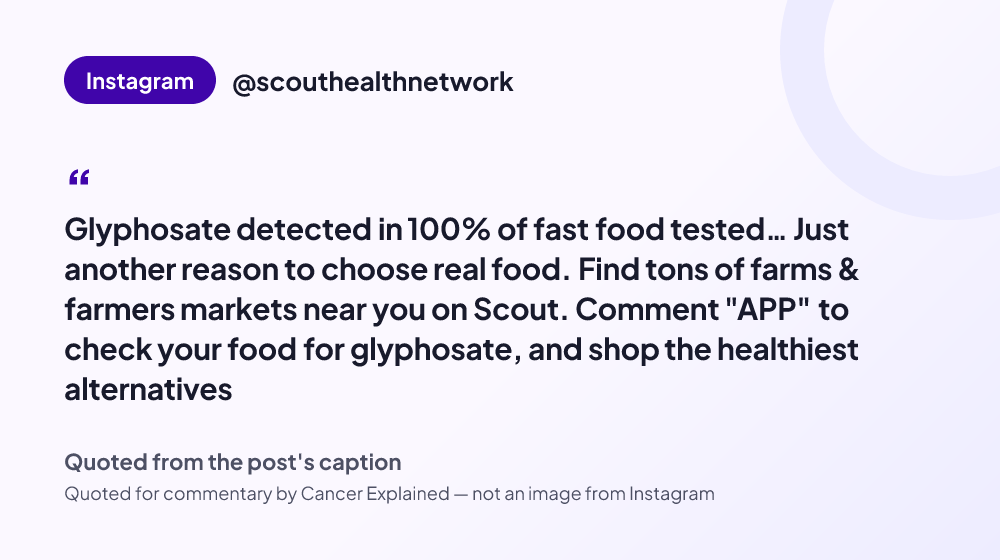
An Instagram post from Scout, a food-scanning app, says glyphosate turned up in every fast food sample a lab tested. Glyphosate is the weedkiller sold as Roundup. The post tells readers to pick "real food" instead. It also asks them to comment a keyword to get the app. The app checks their food and points them to other choices.
What's real
There is a real test behind this. In 2023, the advocacy group Moms Across America sent 42 fast food samples from 21 chains to a lab. The chains included McDonald's, Chipotle, Panera Bread and Arby's. Glyphosate showed up in all of them. Panera Bread's samples had the most, combining for about 439 parts per billion (ppb) across two meals. Chipotle's had the least, about 5 ppb. So "100%" is an accurate description of that one report's results. Glyphosate is the most used weedkiller in the world. Small traces on food are common. So finding some in a fast food sample isn't surprising.
It's also true, as our glyphosate and cancer page explains, that the World Health Organization's cancer agency (IARC) classifies glyphosate as a probable human carcinogen. Scientists truly disagree about this. The U.S. EPA and European regulators came to a different view. They say it's not likely to cause cancer at the levels people actually come in contact with. Our Prop 65 and glyphosate page covers how that same disagreement ended up in federal court.
What's missing
The post doesn't say how much glyphosate was found, only that it was "detected." That distinction matters. Today's lab tools can find chemicals in very tiny amounts. Often these are far below any level linked to harm. The EPA sets a legal tolerance for how much glyphosate residue is allowed in food. For wheat grain, that tolerance is 5 parts per million, or 5,000 ppb. The highest result in the report was Panera's, at about 439 ppb combined. That is more than 10 times below the limit for raw wheat alone. And a fast food meal is a mix of many foods, not straight grain. "Detected" is not the same as "over a safety limit." The post doesn't mention a limit at all.
It's also worth naming what the post is: an advertisement. Scout is an app that sells food-scanning and shopping recommendations. Posting a scary number and asking readers to comment a keyword for the app is a sales tactic. It is not a public health notice from a food safety agency. That doesn't make the lab result fake. But it means the post has a reason to make the finding sound as urgent as it can.
What to do with this
It's reasonable to want less pesticide on your food. Washing produce or buying from local farms is a fine way to act on that. But one word, "detected," in an ad isn't proof that a fast food meal carries a real cancer risk. Want to understand your own exposure to glyphosate or other chemicals? Our cancer risk factors overview is a better place to start than one Instagram graphic.
Sources
- Moms Across America, "100% of Top Twenty Fast Food Brands Positive for Glyphosate" (2023 lab report): momsacrossamerica.com
- U.S. EPA, glyphosate tolerances for food commodities, 40 CFR § 180.364: federalregister.gov
- International Agency for Research on Cancer, glyphosate classification: iarc.who.int
- Cancer Explained, "Glyphosate and Cancer: Why Experts Disagree": /carcinogens/glyphosate-and-cancer/
- National Cancer Institute, "Environmental Carcinogens and Cancer Risk": cancer.gov
How this article was prepared
An AI-assisted editorial system helped prepare this page. It used the public Moms Across America lab report and the EPA's published limits. It also used IARC's rating of glyphosate. No named medical reviewer has reviewed it unless one is listed.
Cancer Explained is published by the National Cancer Information Foundation. It is not medical advice and does not suggest a test or treatment.
See an error, old source, or unclear wording? Tell us.
Know someone who needs this?
Plenty of people are looking for something like this and do not know where to start. If this would help a friend or someone you love, send it on — we have written an opening line so you do not have to stare at an empty message. You can change every word of it.
Your message is written and sent in your own email or messaging app — we never see who you send it to, and nothing is added to any list.
Put the story in context
Prevention, possible warning signs, screening, and diagnosis
This story relates to general. The information below is general: it does not reveal anything else about a public person’s health, and not every point applies to every cancer. Personal advice depends on age, symptoms, family history, exposures, and medical history.
Prevention and risk reduction
Not every cancer can be prevented. Avoiding tobacco, protecting skin from ultraviolet radiation, limiting alcohol, staying active, and receiving recommended HPV or hepatitis B vaccination can lower the risk of certain cancers. A risk factor is not a prediction or a cause in one individual.
Symptoms and possible early signs
Possible signs vary and are often caused by conditions other than cancer. Changes worth discussing include a new lump, unexplained bleeding or weight loss, a persistent cough, lasting bowel or bladder changes, a changing skin spot, or symptoms that persist or worsen. Some early cancers cause no symptoms.
Screening and early detection
Screening looks for certain cancers before symptoms begin. Recommended tests exist only for some cancers and depend on age and risk. Screening can have benefits and harms; it is not the same as evaluating a new symptom, and there is no single routine scan or blood test that reliably screens for every cancer.
How cancer is diagnosed
Diagnosis may involve a history and exam, imaging, laboratory tests, and often a biopsy. Pathology can identify the cancer type and may test biomarkers that guide treatment. Symptoms, screening results, tumor markers, or online stories alone cannot confirm cancer.
A public story may encourage questions, but it should not be used to estimate your risk or choose testing. Contact a healthcare professional about a persistent or concerning change. Seek urgent care for severe or rapidly worsening symptoms.