
NewsMovies & TV
No, a Viral 'Sunscreen Causes Skin Cancer' Reel Doesn't Hold Up
A viral Instagram Reel claims a massive study proves sunscreen users get more skin cancer than non-users. Here's what the study actually shows, and why UV exposure — not sunscreen — is the real driver.
Original commentary from the Cancer Explained editorial team.


Please note: this page is educational only — it is not medical advice, and it does not speculate about anyone’s health beyond reliable public reporting. For questions about your own health, talk with your healthcare team.
“The LARGEST sunscreen-skin cancer study EVER done (n=470,000) found sunscreen users faced dramatically higher risks of ALL major skin cancers”
Nothing has loaded from Instagram. We do not connect you to Meta unless you ask, because that would let them set cookies through this page. Open it on Instagram instead.
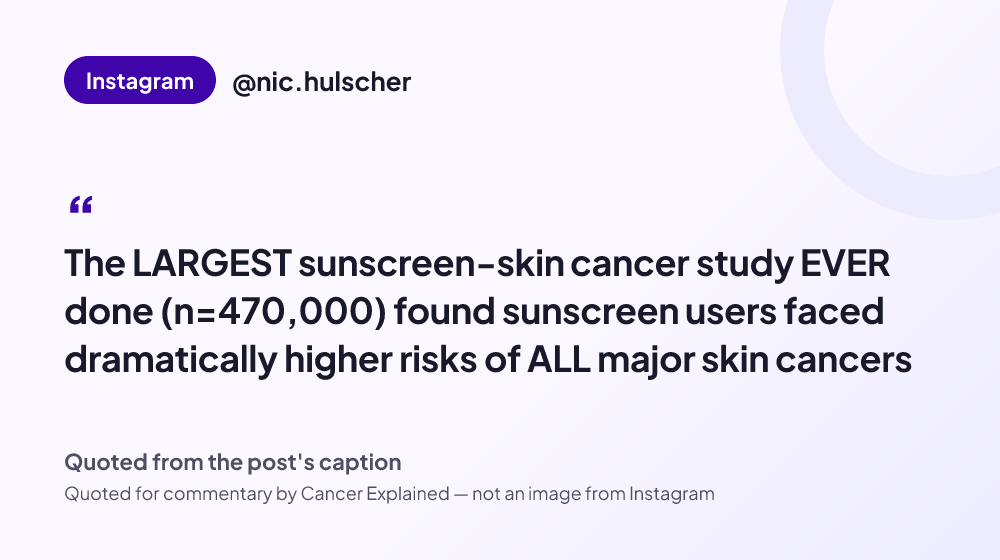
A viral Instagram Reel from the account nic.hulscher makes a startling claim. It says "the LARGEST sunscreen-skin cancer study EVER done" covered roughly 470,000 people. It claims that study found sunscreen users had far higher rates of skin cancer than non-users. The numbers cited: supposedly 292% higher for invasive melanoma, 258% higher for melanoma in situ, 140% higher for basal cell carcinoma, and 126% higher for squamous cell carcinoma. The post frames this as evidence that sunscreen itself is dangerous. Or, at least, that public health advice to wear it is backwards.
That is a big, scary-sounding number, and it is exactly the kind of statistic that spreads fast because it seems to flip conventional wisdom on its head. It's worth slowing down and asking what a study like this can and can't actually prove.
What the science actually says
According to the National Cancer Institute, "exposure to UV radiation causes early aging of the skin and damage that can lead to skin cancer," and this holds whether that UV comes from the sun, sunlamps, or tanning beds (cancer.gov). NCI's sun safety guidance recommends using sunscreen with an SPF of at least 15 (many clinicians now recommend SPF 30 or higher), reapplied every two hours or after swimming or sweating, as part of a broader sun-protection strategy.
Mayo Clinic lists the well-established risk factors for skin cancer: skin that burns easily, a history of blistering sunburns, indoor tanning, a personal or family history of skin cancer, and a weakened immune system. Mayo's guidance is direct: "Use a broad-spectrum sunscreen with an SPF of at least 30, even on cloudy days," applied generously and reapplied often, alongside shade-seeking, protective clothing, and regular skin checks (mayoclinic.org).
Large observational studies like the one described in the Reel usually just compare people who report using sunscreen with people who don't. They aren't controlled experiments. Researchers don't randomly assign who wears sunscreen and who doesn't. That distinction matters a lot. People who use sunscreen tend to already know they're at higher risk. They burn easily. They have fair skin. They spend more time deliberately in the sun — at the beach, hiking, gardening. Or they've already had a skin cancer scare and are now careful. In epidemiology, this is called confounding by indication. The sunscreen isn't causing the cancer risk. It's a marker of who already had higher sun exposure, or higher baseline risk, and is trying to manage it. Decades of evidence point the other direction, including randomized trial data cited by NCI and other federal bodies. Cumulative UV exposure and sunburn history drive skin cancer risk. Sunscreen reduces measurable harm, such as sunburn, and, in trial data, melanoma rates over long-term follow-up.
What this video gets right or wrong
The Reel is right about one thing: a single statistic, taken alone, can look alarming. It's fair to be skeptical of any product claim that isn't backed by evidence. But the video gets the underlying science wrong. It treats a correlation from an observational dataset as if it proves sunscreen causes skin cancer. It skips a much simpler explanation. People who already sunburn easily, spend more time outdoors, or worry more about their skin are also more likely to buy and use sunscreen in the first place. The Reel's caption doesn't say how the study adjusted for sun exposure, skin type, or outdoor jobs. Without that, the raw percentage increases it cites don't tell us what caused what. No major cancer authority — not NCI, CDC, FDA, or Mayo Clinic — has changed its guidance based on this framing. All still recommend sunscreen as a core, evidence-based prevention tool.
Signs and symptoms
Because this claim touches on skin cancer generally, it's worth knowing the warning signs. They include a new or changing mole or a sore that doesn't heal. They also include a spot that's asymmetrical, has an irregular border, uneven color, is larger than a pencil eraser, or is evolving in size, shape, or color (the "ABCDE" rule). Most unusual-looking spots or skin changes turn out to be benign, such as moles, age spots or minor irritation. But any changing or persistent skin lesion should be checked by a clinician rather than self-diagnosed from a video.
What to do instead
The practical guidance from NCI, CDC, and Mayo Clinic hasn't changed. Seek shade, especially between 10 a.m. and 3 p.m. Wear protective clothing and a wide-brimmed hat. Use a broad-spectrum sunscreen of SPF 15–30 or higher. Reapply it every two hours, or after swimming and sweating. Avoid tanning beds entirely — they're a known cause of skin cancer. Do regular skin self-exams. See a dermatologist for anything new, changing, or unusual. For more detail, see the NCI's page on sunlight and skin cancer risk (cancer.gov) and CDC's skin cancer prevention resources (cdc.gov). If you're ever unsure whether a headline or Reel about sunscreen, sunlight, or cancer prevention is accurate, check it against a primary source before you change your own habits.
Fact-checking claims like this one takes time and careful sourcing, and free, evidence-based cancer information doesn't happen by accident. Organizations like the National Cancer Information Foundation work to keep information like this free and accessible to anyone trying to sort real evidence from viral misinformation. If that work is useful to you, consider supporting it.
How this article was prepared
An AI-assisted editorial system helped prepare this page. No named medical reviewer has reviewed it unless one is listed.
Cancer Explained is published by the National Cancer Information Foundation. It is not medical advice and does not suggest a test or treatment.
See an error, old source, or unclear wording? Tell us.
Know someone who needs this?
Plenty of people are looking for something like this and do not know where to start. If this would help a friend or someone you love, send it on — we have written an opening line so you do not have to stare at an empty message. You can change every word of it.
Your message is written and sent in your own email or messaging app — we never see who you send it to, and nothing is added to any list.
Put the story in context
Prevention, possible warning signs, screening, and diagnosis
This story relates to melanoma. The information below is general: it does not reveal anything else about a public person’s health, and not every point applies to every cancer. Personal advice depends on age, symptoms, family history, exposures, and medical history.
Prevention and risk reduction
Not every cancer can be prevented. Avoiding tobacco, protecting skin from ultraviolet radiation, limiting alcohol, staying active, and receiving recommended HPV or hepatitis B vaccination can lower the risk of certain cancers. A risk factor is not a prediction or a cause in one individual.
Symptoms and possible early signs
Possible signs vary and are often caused by conditions other than cancer. Changes worth discussing include a new lump, unexplained bleeding or weight loss, a persistent cough, lasting bowel or bladder changes, a changing skin spot, or symptoms that persist or worsen. Some early cancers cause no symptoms.
Screening and early detection
Screening looks for certain cancers before symptoms begin. Recommended tests exist only for some cancers and depend on age and risk. Screening can have benefits and harms; it is not the same as evaluating a new symptom, and there is no single routine scan or blood test that reliably screens for every cancer.
How cancer is diagnosed
Diagnosis may involve a history and exam, imaging, laboratory tests, and often a biopsy. Pathology can identify the cancer type and may test biomarkers that guide treatment. Symptoms, screening results, tumor markers, or online stories alone cannot confirm cancer.
Learn about this story’s cancer topic
A public story may encourage questions, but it should not be used to estimate your risk or choose testing. Contact a healthcare professional about a persistent or concerning change. Seek urgent care for severe or rapidly worsening symptoms.