
NewsMovies & TV
Does Chemo Really 'Destroy the Cells That Fight Cancer'? What a Viral Claim About Natural Killer Cells Gets Right
A viral Instagram Reel claims chemotherapy and radiation destroy the natural killer cells that protect against cancer. Here's what the evidence actually shows.
Original commentary from the Cancer Explained editorial team.


Please note: this page is educational only — it is not medical advice, and it does not speculate about anyone’s health beyond reliable public reporting. For questions about your own health, talk with your healthcare team.
“Chemotherapy and radiation target tumors directly but in the process systematically destroy natural killer cells, the body's first responder against cancer, tuberculosis, HIV, and viral infections.”
Nothing has loaded from Instagram. We do not connect you to Meta unless you ask, because that would let them set cookies through this page. Open it on Instagram instead.
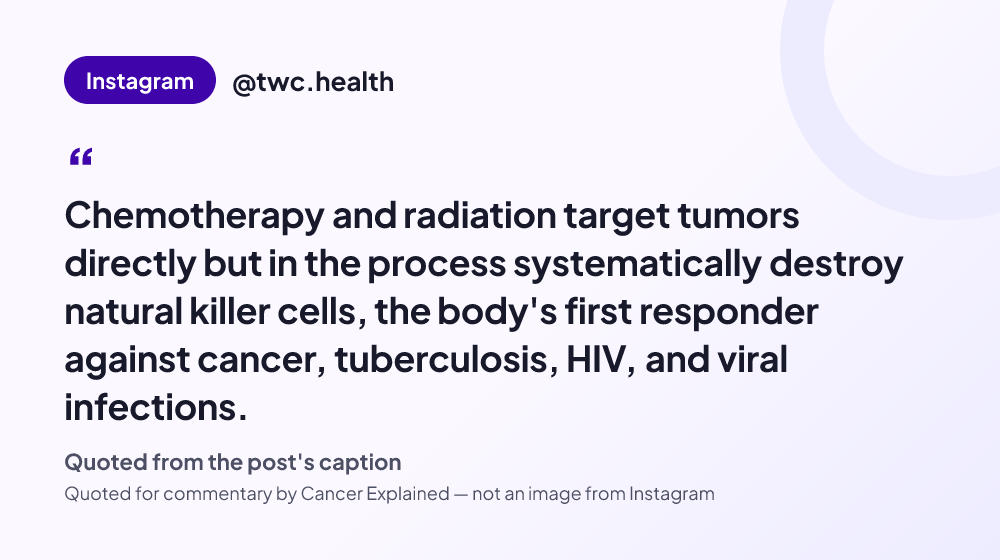
A Reel from the account @twc.health has been spreading fast. It makes a striking claim: oncologist and biotech founder Dr. Patrick Soon-Shiong has "spent decades building a case that oncology has been solving the wrong problem." The caption argues that chemotherapy and radiation aim at tumors, but "systematically destroy natural killer cells" too. The post calls these immune cells the body's "first responder" against cancer, tuberculosis, HIV, and viral infections. Without them, it says, "tumors are free to grow, adapt, and spread."
It's a compelling story: standard cancer treatment as the villain, undermining the very defenses that could beat cancer on their own. But like a lot of viral health content, it takes a real, well-documented fact and stretches it into a much bigger, misleading claim.
What the science actually says
Natural killer (NK) cells are real. They really are part of the body's built-in defense against abnormal and virus-infected cells. That much is accurate. It's also true that chemotherapy suppresses the immune system, including white blood cells. The National Cancer Institute (NCI) states plainly that chemotherapy drugs "lower the number of white blood cells, the cells that help your body to fight infection." At certain points in a treatment cycle, neutrophil counts get "particularly low." That raises infection risk enough that NCI calls infections during treatment potentially "life threatening" and something needing urgent medical care.
Mayo Clinic says something similar. Chemotherapy works by killing fast-growing cells throughout the body, not just tumor cells. "Some chemotherapy may reduce your body's ability to fight infections." Radiation can also temporarily lower immune cell counts, especially when it targets bone marrow (where immune cells are made) or lymph nodes. None of this is secret or hidden. It's standard information given to every patient starting treatment. That's exactly why oncology teams run blood counts throughout chemotherapy. They delay or adjust doses when white blood cell counts drop too low.
Here's where the Reel goes off the rails. It jumps from "treatment temporarily lowers immune cell counts" to "oncology has the wrong idea" — and to tumors left free to "grow, adapt, and spread." That is not what the evidence shows. Chemo and radiation don't aim to boost the immune system. They were never meant to. But years of trials show they shrink tumors, cut relapse, and help people live longer, across many cancer types. They kill cancer cells directly, immune system aside. A side effect — a short drop in immune cells — doesn't mean the whole plan is wrong. It doesn't mean patients are worse off using it.
It's also worth noting cancer doctors haven't ignored the immune system. Quite the opposite. NCI describes a whole treatment type, immunotherapy, built on one idea: "the immune system naturally detects and destroys abnormal cells," and giving that response a boost can fight cancer. Checkpoint inhibitors, CAR T-cell therapy, and NK-cell approaches (the kind Soon-Shiong's own company makes and sells) are real, active research areas. They're often studied alongside chemo and radiation, not in place of them.
What this video gets right or wrong
Right: Chemotherapy and radiation can suppress immune cell counts, including cells involved in innate immunity, for a period during and after treatment. This is well established. Oncology teams take it seriously.
Wrong or misleading: The claim that this makes standard oncology "the wrong problem" isn't backed by evidence. Neither is the implication that patients would be better off avoiding proven treatments to protect immune function. The Reel also skips an important conflict of interest: the featured physician's company develops and profits from NK-cell immune therapies. That gives him a direct financial stake in a story that casts standard chemo and radiation in a bad light. That doesn't make everything he says false. But it's a relevant detail a 60-second Reel won't tell you. It's a classic pattern in health misinformation: a real mechanism, dramatized into a sweeping claim that happens to favor a product.
Signs and symptoms to know
Chemotherapy and radiation can lower white blood cell counts. Because of that, oncology teams watch closely for signs of infection during treatment: a fever of 100.4°F (38°C) or higher, along with chills, sore throat, cough, or unusual fatigue. The fever number is sometimes printed as 100.5°F, a rounding difference; 100.4°F is the number CDC says to act on. Most infections, and most cases of fatigue, fever, or other general symptoms, have causes that have nothing to do with cancer or its treatment. Patients on chemotherapy are simply told to report these symptoms right away. The stakes are higher when white blood cell counts are low — not because something has gone wrong with the treatment itself.
What to do instead
If you or someone you love is thinking about cancer treatment, the immune-suppression side effect in this Reel is real. It is a conversation to have with an oncologist, not a social media algorithm. Ask about blood count monitoring, growth-factor support if needed, and how your specific plan balances effectiveness against side effects. NCI's overview of managing infection risk during treatment (cancer.gov), and its resources on immunotherapy, are good starting points. They help you understand both sides: how chemotherapy affects immune cells, and how immune-based treatments are actually studied and used alongside it — not as a replacement based on an Instagram Reel's say-so. The CDC and FDA also keep resources on infection prevention and approved treatment options for patients in active cancer therapy.
Skipping or delaying evidence-based treatment based on a viral claim is one of the more serious forms of cancer misinformation. The cost of being wrong is measured in outcomes, not just misinformation.
Nonprofit health information — the kind that fact-checks viral claims instead of monetizing fear or alternative products — depends on donor support to stay free and ad-free. Organizations like the National Cancer Information Foundation work to keep information like this free and open for anyone trying to make sense of what they see online.
How this article was prepared
An AI-assisted editorial system helped prepare this page. No named medical reviewer has reviewed it unless one is listed.
Cancer Explained is published by the National Cancer Information Foundation. It is not medical advice and does not suggest a test or treatment.
See an error, old source, or unclear wording? Tell us.
Watch: Is chemo worse than the cancer?
26 sec · Captioned · Side effects are real, but for a curable cancer, refusing treatment carries the bigger risk.
Educational only — this video explains general report language and is not medical advice. Only your care team can say what a result means for you.
Open this video's own page →Know someone who needs this?
Plenty of people are looking for something like this and do not know where to start. If this would help a friend or someone you love, send it on — we have written an opening line so you do not have to stare at an empty message. You can change every word of it.
Your message is written and sent in your own email or messaging app — we never see who you send it to, and nothing is added to any list.
Put the story in context
Prevention, possible warning signs, screening, and diagnosis
This story relates to general-oncology. The information below is general: it does not reveal anything else about a public person’s health, and not every point applies to every cancer. Personal advice depends on age, symptoms, family history, exposures, and medical history.
Prevention and risk reduction
Not every cancer can be prevented. Avoiding tobacco, protecting skin from ultraviolet radiation, limiting alcohol, staying active, and receiving recommended HPV or hepatitis B vaccination can lower the risk of certain cancers. A risk factor is not a prediction or a cause in one individual.
Symptoms and possible early signs
Possible signs vary and are often caused by conditions other than cancer. Changes worth discussing include a new lump, unexplained bleeding or weight loss, a persistent cough, lasting bowel or bladder changes, a changing skin spot, or symptoms that persist or worsen. Some early cancers cause no symptoms.
Screening and early detection
Screening looks for certain cancers before symptoms begin. Recommended tests exist only for some cancers and depend on age and risk. Screening can have benefits and harms; it is not the same as evaluating a new symptom, and there is no single routine scan or blood test that reliably screens for every cancer.
How cancer is diagnosed
Diagnosis may involve a history and exam, imaging, laboratory tests, and often a biopsy. Pathology can identify the cancer type and may test biomarkers that guide treatment. Symptoms, screening results, tumor markers, or online stories alone cannot confirm cancer.
A public story may encourage questions, but it should not be used to estimate your risk or choose testing. Contact a healthcare professional about a persistent or concerning change. Seek urgent care for severe or rapidly worsening symptoms.