
News
Does Dawn Dish Soap Cause Cancer? An Instagram Claim, Checked
An Instagram post says Dawn dish soap contains or makes cancer-linked substances. Here is what EPA, FDA, NCI and Dawn's own ingredient page say.
Original commentary from the Cancer Explained editorial team.


Please note: this page is educational only — it is not medical advice, and it does not speculate about anyone’s health beyond reliable public reporting. For questions about your own health, talk with your healthcare team.
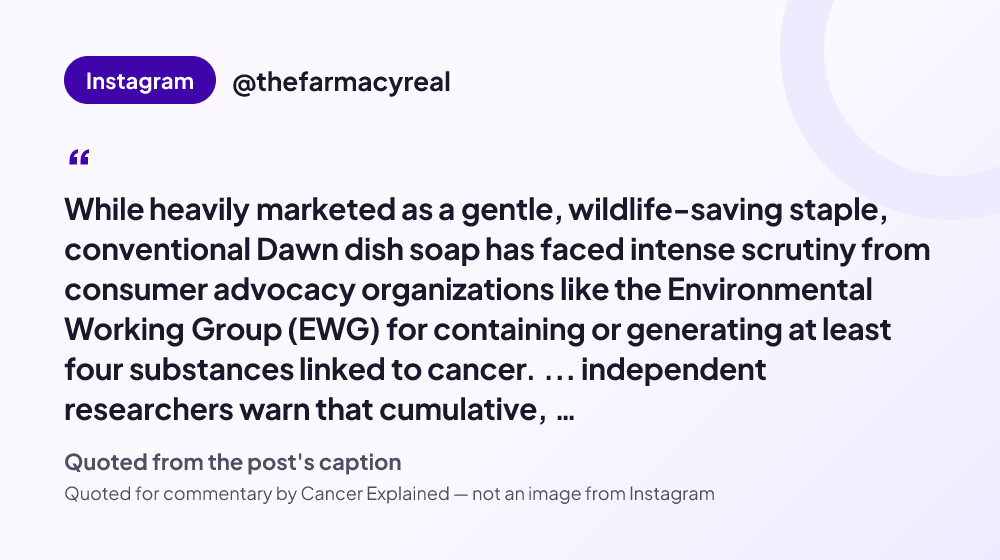
“While heavily marketed as a gentle, wildlife-saving staple, conventional Dawn dish soap has faced intense scrutiny from consumer advocacy organizations like the Environmental Working Group (EWG) for containing or generating at least four substances linked to cancer. ... independent researchers warn that cumulative, long-term exposure to these microscopic chemical residues introduces avoidable, chronic health risks directly to the dinner table.”
Nothing has loaded from Instagram. We do not connect you to Meta unless you ask, because that would let them set cookies through this page. Open it on Instagram instead.
The claim, and the verdict
An Instagram post from @thefarmacyreal says conventional Dawn dish soap contains or generates "at least four substances linked to cancer." It names 1,4-dioxane, "formaldehyde-releasing preservatives," and synthetic fragrances and dyes such as Acid Blue 9. It then says "cumulative, long-term exposure to these microscopic chemical residues" on plates and bottles creates "avoidable, chronic health risks." It ends by pointing readers to other brands.
Verdict: misleading. One concern in the post is real. But the post treats "a substance can cause cancer at some exposure" as if it meant "this product causes cancer in your kitchen." Sources we read do not support that jump.
What is true: 1,4-dioxane can be a trace contaminant
1,4-dioxane is not an ingredient. FDA describes it as "a trace contaminant in some cosmetic products" that "forms as a byproduct during the manufacturing process of certain cosmetic ingredients." EPA likewise refers to it as a contaminant in "commercial and consumer products like dish soaps and laundry detergents."
Its cancer status is real too. FDA notes that the National Toxicology Program found it "reasonably anticipated to be a human carcinogen." IARC, the World Health Organization's cancer agency, classifies it as "possibly carcinogenic to humans (Group 2B)." That is based on "sufficient evidence" in experimental animals and "inadequate evidence" in humans. For 1,4-dioxane overall, EPA identified cancer risk from two sources. One is inhalation or dermal exposure (breathing it in or contact with skin). Its 2024 determination ties this to worker exposures during manufacturing and processing. The other is drinking water from contaminated surface water. FDA's page says EPA classifies it as "likely to be carcinogenic to humans." The post's "probably" is therefore close to EPA's wording. The disagreement is about exposure, not the hazard label.
What the post leaves out: EPA looked at consumer use
EPA's 2020 risk evaluation looked at consumers using detergents and cleaning products that contain 1,4-dioxane as a contaminant. It "found that the use did not present an unreasonable risk to consumers or bystanders." In its November 2024 revised determination, EPA says it "does not identify risks to consumers from the use of these products as contributing to the unreasonable risk determination from 1,4-dioxane."
EPA's concern is water: dish soap and detergent that goes down the drain can reach surface water used for drinking. That is an issue for the environment and water utilities. It is separate from the plate in front of you.
Limits exist as well. In New York, the state environmental agency lists a limit of 1 ppm for 1,4-dioxane in household cleansing and personal care products as of December 31, 2023. We did not find a Dawn-specific test result. So we cannot say what any particular bottle contains.
Does Dawn use formaldehyde-releasing preservatives? We could not confirm it
Formaldehyde is a recognized carcinogen. NCI says IARC classifies it as a human carcinogen and NTP calls it known. NCI describes an increased risk of death from leukemia among exposed workers. It says the risk "was associated with increasing peak and average levels of exposure, as well as with the duration of exposure."
The post says Dawn uses formaldehyde-releasing preservatives. Dawn's ingredient page labels methylisothiazolinone as a "non-formaldehyde preservative." It lists other ingredients such as phenoxyethanol, chloroxylenol and fragrance. The page does not describe their function as preservation. We did not evaluate those other ingredients. Neither formaldehyde nor 1,4-dioxane is mentioned on that page. Ingredients can differ between Dawn products and change over time. Check the label on the bottle you own. On the page we read, we could not confirm the post's claim.
Dyes: Acid Blue 9 is not on Dawn's page
The post names Acid Blue 9. Dawn's ingredient page lists "colorants, Blue 1, Yellow 5, Red 33" and does not mention Acid Blue 9. FDA rules allow FD&C Blue No. 1 for coloring foods and drugs, in amounts consistent with good manufacturing practice. We did not check FDA's status for its use in soap. We did not establish whether Acid Blue 9 and FD&C Blue 1 are the same substance. This article does not judge dyes beyond that.
The post also says fragrance and dyes "can mask endocrine disruptors." Dawn's page lists "fragrances" without naming components. We found no source in our review that supports the endocrine-disruptor statement for this product, so we leave that unrated.
Residue on dishes: we found no study
The post's central claim is that leftover film on rinsed dishes adds up to a chronic cancer-type risk. In the pages we reviewed, we did not find an FDA, EPA or NCI statement showing that residue on rinsed dishes causes cancer. We did not find a study showing it either. That is not proof of zero risk. It means the claim is unsupported by what we could find.
NCI states the underlying principle plainly: "Simply because a substance has been designated as a carcinogen, however, does not mean that the substance will necessarily cause cancer." Amount, duration and genetic background all matter. NTP's Report on Carcinogens lists substances "known or reasonably anticipated to cause cancer in humans."
About the sources the post relies on
We could not read any Environmental Working Group page (its site refused our requests), so we do not state what it rates Dawn or why.
What this does not mean
- It does not mean every dish soap is the same or that nothing in one deserves attention.
- It does not mean anyone with a skin reaction to a soap should ignore it. A pharmacist or clinician can help with irritation or allergy.
- It does not rule out future research. The absence of a study we found is not a guarantee.
- It is not advice to switch or stay with any brand, and we do not endorse the brands the post promotes.
For more, see our pages on household cleaning products and cancer risk, formaldehyde and cancer, what a carcinogen is and how to read a carcinogen classification.
Sources
- https://www.instagram.com/p/Ddt5aRCquMF/
- https://epa.gov/assessing-and-managing-chemicals-under-tsca/final-risk-evaluation-14-dioxane
- https://www.fda.gov/cosmetics/potential-contaminants-cosmetics/14-dioxane-cosmetics-manufacturing-byproduct
- https://dec.ny.gov/environmental-protection/pollution-prevention/household-personal-cosmetic-dioxane-limits
- https://www.cancer.gov/about-cancer/causes-prevention/risk/substances/formaldehyde/formaldehyde-fact-sheet
- https://www.cancer.gov/about-cancer/causes-prevention/risk/substances
- https://ntp.niehs.nih.gov/whatwestudy/assessments/cancer/roc/index.html
- https://inchem.org/documents/iarc/vol71/019-dioxane.html
- https://dawn-dish.com/en-us/how-to/what-dawn-is-made-of-ingredients/
- https://www.law.cornell.edu/cfr/text/21/74.101
- https://www.law.cornell.edu/cfr/text/21/74.1101
An AI-assisted editorial system helped prepare this page. No named medical reviewer has reviewed it unless one is listed.
See an error, old source, or unclear wording? Tell us.
Know someone who needs this?
Plenty of people are looking for something like this and do not know where to start. If this would help a friend or someone you love, send it on — we have written an opening line so you do not have to stare at an empty message. You can change every word of it.
Your message is written and sent in your own email or messaging app — we never see who you send it to, and nothing is added to any list.
Put the story in context
Prevention, possible warning signs, screening, and diagnosis
This story relates to Household chemicals and cancer risk. The information below is general: it does not reveal anything else about a public person’s health, and not every point applies to every cancer. Personal advice depends on age, symptoms, family history, exposures, and medical history.
Prevention and risk reduction
Not every cancer can be prevented. Avoiding tobacco, protecting skin from ultraviolet radiation, limiting alcohol, staying active, and receiving recommended HPV or hepatitis B vaccination can lower the risk of certain cancers. A risk factor is not a prediction or a cause in one individual.
Symptoms and possible early signs
Possible signs vary and are often caused by conditions other than cancer. Changes worth discussing include a new lump, unexplained bleeding or weight loss, a persistent cough, lasting bowel or bladder changes, a changing skin spot, or symptoms that persist or worsen. Some early cancers cause no symptoms.
Screening and early detection
Screening looks for certain cancers before symptoms begin. Recommended tests exist only for some cancers and depend on age and risk. Screening can have benefits and harms; it is not the same as evaluating a new symptom, and there is no single routine scan or blood test that reliably screens for every cancer.
How cancer is diagnosed
Diagnosis may involve a history and exam, imaging, laboratory tests, and often a biopsy. Pathology can identify the cancer type and may test biomarkers that guide treatment. Symptoms, screening results, tumor markers, or online stories alone cannot confirm cancer.
Learn about this story’s cancer topic
A public story may encourage questions, but it should not be used to estimate your risk or choose testing. Contact a healthcare professional about a persistent or concerning change. Seek urgent care for severe or rapidly worsening symptoms.
Related Cancer Explained resources
- Prevention & RiskHousehold cleaning products and cancer risk
- Carcinogens & RegulationFormaldehyde and Cancer: Home and Work Exposure
- Carcinogens & RegulationWhat Is a Carcinogen? What the Label Means
- Carcinogens & RegulationHow to Read a Carcinogen Classification
- Carcinogens & RegulationKnown vs. Suspected Carcinogens